
Egg and Sperm Donation
Help someone start the family they’ve hoped for.

Help someone start the family they’ve hoped for.
Many families in South Australia exist because someone chose to donate. Whether you’re thinking about donating eggs or sperm, our donor team will guide you from your first enquiry through to your final appointment, at your pace and with no pressure.
All donors need to:
-Be Australian citizens or permanent residents
-Be in good general health
-Be able to provide a family medical history (self, children, siblings, parents, and grandparents)
-Attend counselling, medical assessments, and screening tests
-Agree to be identifiable to any donor-conceived person once they turn 18
Egg donors need to be aged 21 to 35.
Sperm donors need to be aged 21 to 40 with an adequate semen profile.
In South Australia, donors can’t be paid for their eggs or sperm, but we ensure donors have no out-of-pocket costs.

Some people can’t start a family without the help of a donor.
Donor eggs can help women whose own eggs are unlikely to lead to a pregnancy, for example because of low ovarian reserve, early menopause, cancer treatment, or a genetic condition they don’t want to pass on.
Donor sperm can help single women, same-sex female couples, and heterosexual couples affected by male infertility.
All recipients meet with our counsellors to understand what using a donor means for them and their future children.
Every donor makes a real difference, and many tell us knowing they’ve helped someone become a parent is deeply rewarding.

Throughout your journey, Georgia and Sue, our dedicated donor coordinators, will provide guidance and answer your questions. We understand that this is an important decision, and they are here to guide you every step of the way. They’ll coordinate your appointments, keep you updated on your progress, and make sure everything runs as smoothly as possible.
Our counsellors, Julie, Carrie, and Emma, are available to support you through the emotional issues you could face. They’ll give you space to ask questions, talk through how you’re feeling, and make sure you feel confident in your decision. Their support doesn’t end once you’ve donated, so you can reach out to them whenever you need.
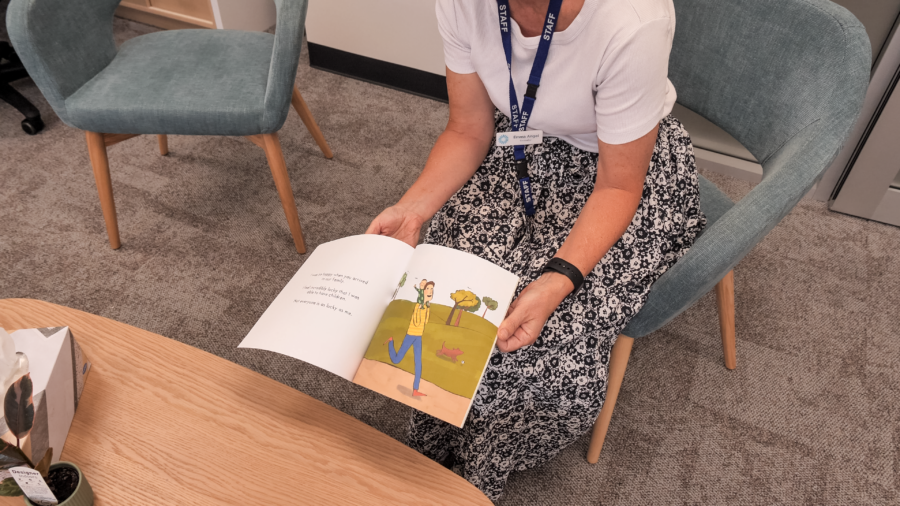
Any child born from donated eggs or sperm can request access to their donor’s details once they reach the age of 18. This reflects the changing dynamics of modern families and emphasises the importance of transparency and openness in the process.
Many donor-conceived people simply want to understand more about their background, their medical history, or the person who helped bring them into the world.
As a donor, you are under no obligation to have or remain in contact with a donor-conceived person. Our counsellors will help you consider your reactions and feelings should contact occur.

For more information and to embark on this journey, please complete the form below and our donor coordinator will contact you.
For all donors:
A doctor takes your full medical history
You’ll have infectious disease screening and expanded carrier screening
Once you’re eligible, you’ll start counselling
For sperm donors, you’ll then have a semen analysis and make several donations for freezing.
For egg donors, you’ll then have a treatment cycle to stimulate your ovaries, followed by an egg collection.
Sperm donors attend several appointments until enough samples are frozen; the lab and donor coordinator will keep you updated.
Egg donors usually complete one treatment cycle if they don't already have eggs in storage from a previous cycle.
Yes. In South Australia, a maximum of 10 families can be created from any one sperm donor. You can request a lower limit if you prefer.
For egg donors, while the limit is the same, it is more likely that your donation will help one or two families.
Donors should be in good general health and have no history of hereditary disease. Donors will not be accepted if they suffer from an illness, disease, or genetic condition that poses an unacceptable risk of being passed on to any child conceived from the donation.
This will all be thoroughly discussed with you by your doctor.
Under South Australian law, a donor has no parental rights or duties to any children arising from their donation. The recipient (and partner if they have one) are recorded on the birth certificate along with a notation that donor gametes were used. Upon reaching adulthood it may, in future, be possible for the child to request that the name of the donor is included in the birth certificate; this does not constitute an acknowledgment of parentage for the purposes of the Family Relationship Act 1975 or any other law, however.
At any stage, you can withdraw your consent for donation.
In South Australia, we are required to contact you annually to reaffirm your consent for your gametes to be used. If you do not consent, your gametes will be removed from storage and disposed. Recipients who have chosen you as a donor will be advised, and the gametes removed from their allocation. Please note that any embryos created and frozen can still be used by recipients.
Once a child is born, their information will be provided to the SA Donor Conception Register. When a child reaches the age of 18, they have the right to access your information through the register.
All of this will be discussed in detail with you by our counsellors.
In Australia, the donation of reproductive material must be 'altruistic' i.e. done for the benefit of others, not for payment. It is actually illegal to pay donors. However, we ensure there are no out-of-pocket costs for donors.
The donor pathway includes two counselling sessions. If you have a partner, they will need to attend at least one of these.
Counselling provides the time and space for you to explore the emotional aspects of donation as well as discuss future scenarios. For example, how you may feel about having offspring that you may never meet, or conversely how you will feel if they reach out to you as adults.
In the past in Australia donation was anonymous and a growing cohort of donor-conceived children are now searching for answers about their donors - and therefore about themselves.
Legislation now stipulates that on reaching the age of 18 any donor-conceived person can request and receive identifying details of their donor.
This information is housed in a central Donor Conception Register run by SA Health.
You are under no obligation to meet or maintain contact, however, we find that in most cases donors are in fact open to answering questions about themselves, and their medical history.
All donors have expanded carrier screening for recessive genetic conditions. Most people carry at least one genetic condition without knowing it, because it doesn’t affect their own health. A child can be at risk when both biological parents carry the same condition.
If you’re a carrier, a genetic counsellor will talk it through with you so your partner or family can be screened if needed. Occasionally, a result may mean you’re not eligible to donate.
No. Donors can’t place conditions on who receives their donation.